Should I Sell My House Now or Wait? The 7.4% Rate Shock [Salt Lake County]
Anya Bartholomew, MBA · REALTOR®, Equity Real Estate Premier Elite · Utah license 5810503-SA00 (verify) · Draper, Sandy, Cottonwood Heights, Holladay, South JordanPublished October 13, 2026 · Updated October 13, 2026 · Figures checked October 10, 2026
This post will not make me popular with other agents. They price your home as if we are in 2021. They gamble with your equity to win your listing.
Dragging days on the market kills your equity.
Should I sell my house now or wait? Every seller in Salt Lake County is asking it this fall. The mortgage rate jumped to 7.4%. Pending sales fell by almost a third. This post answers the question with four sources — Freddie Mac, the Federal Reserve, the Utah Association of REALTORS® and NAR. It shows what the turn means for you, what the rate did to your buyer's budget, what a lower price costs when you buy lower too, and the number nobody puts on a spreadsheet: what it costs you not to sell.
Why is this important? Three numbers. The 30-year mortgage rate was 7.40% on October 8, 2026, up from 6.30% one year earlier (Freddie Mac). Salt Lake County had 4,140 homes for sale in August 2026 and 846 pending sales, 4.9 homes for sale for every buyer who signed a contract. In August 2021 that number was 1.0 (Utah Association of REALTORS®). Nationally, contract signings are "roughly 30% below where they were in the years leading up to the pandemic" (NAR, September 17, 2026). Fewer buyers, more homes, a higher rate. The market turned. The question is what you do with it. Seller beware.
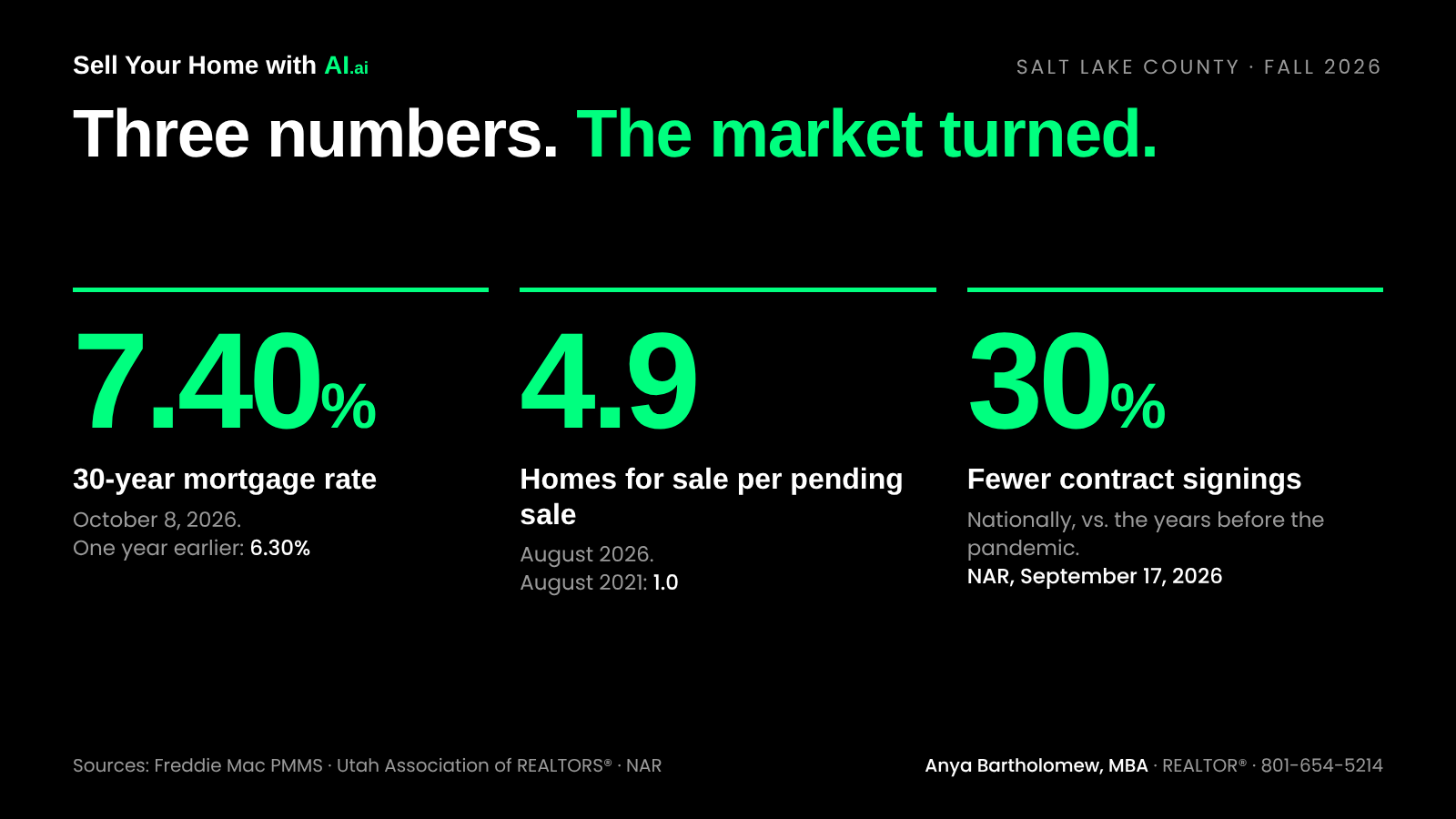
Table of Contents
"It's still a seller's market." — Is Salt Lake County a buyer's market in 2026?
The numbers: six Augusts in Salt Lake County, and the day the balance broke
"There are plenty of buyers out there." — Where did the buyers go?
The numbers: pending sales, the nearly 30% drop, and what the Fed did on September 16
"Rates will come down soon." — What did the rate jump do to your buyer?
"I'll sell when prices come back." — Does a lower price hurt you if you buy at a lower price too?
"We'll wait one more year." — What does it cost you not to sell?
The cost of happiness: what I have watched sellers do, and what the research says
What to do now: the 4-week feedback plan in a buyer's market
Your takeaway: should I sell my house now or wait, and what to say instead
The sellers I remember are the ones who moved
I have been on both sides of this conversation. The seller who says "not this year." And the same seller, a year later, in the home and the place they wanted all along.
Here is what I have watched. Sellers procrastinate. They wait for a better rate, a better month, a better headline. The waiting costs them money, and they know it. What they do not expect is the other side. Once they move to the lifestyle and the location they wanted, they are happy. Fulfilled. Not one has told me "I wish I had waited longer."
That is the lens for this post. The numbers below are hard. The rate jumped. Buyers pulled back. Inventory is the highest in six years. But every number cuts both ways for you, because you are not only a seller. You are a buyer too. The question is not "Is this a bad time to sell?" The question is:
What does it cost me not to move?
Answer it in dollars. Then answer it in years.
1. "It's still a seller's market." — Is Salt Lake County a buyer's market in 2026?
Short answer: No, it is not a seller's market anymore. In August 2021 Salt Lake County had one home for sale for every pending sale. In August 2026 it had 4.9. Homes for sale: up 154%. Pending sales: down 48%. Four months of supply. That is a buyer's market, and the rate jump in September made it stronger.
Many sellers still price their home like it is 2021. The agent who agrees with them wins the listing. The market does not agree with either of them.

What a buyer's market means for you, in one line each:
Buyers have choices. 4,140 homes for sale in August 2026. They can walk away from yours.
Buyers have time. 56 days on market until sale. They are not racing anyone.
Buyers negotiate. 96.4% of original list price received. On $1,000,000, that is $36,000 off before concessions.
Buyers ask for concessions. The UAR price numbers do not include them. Your net is lower than the sold price.
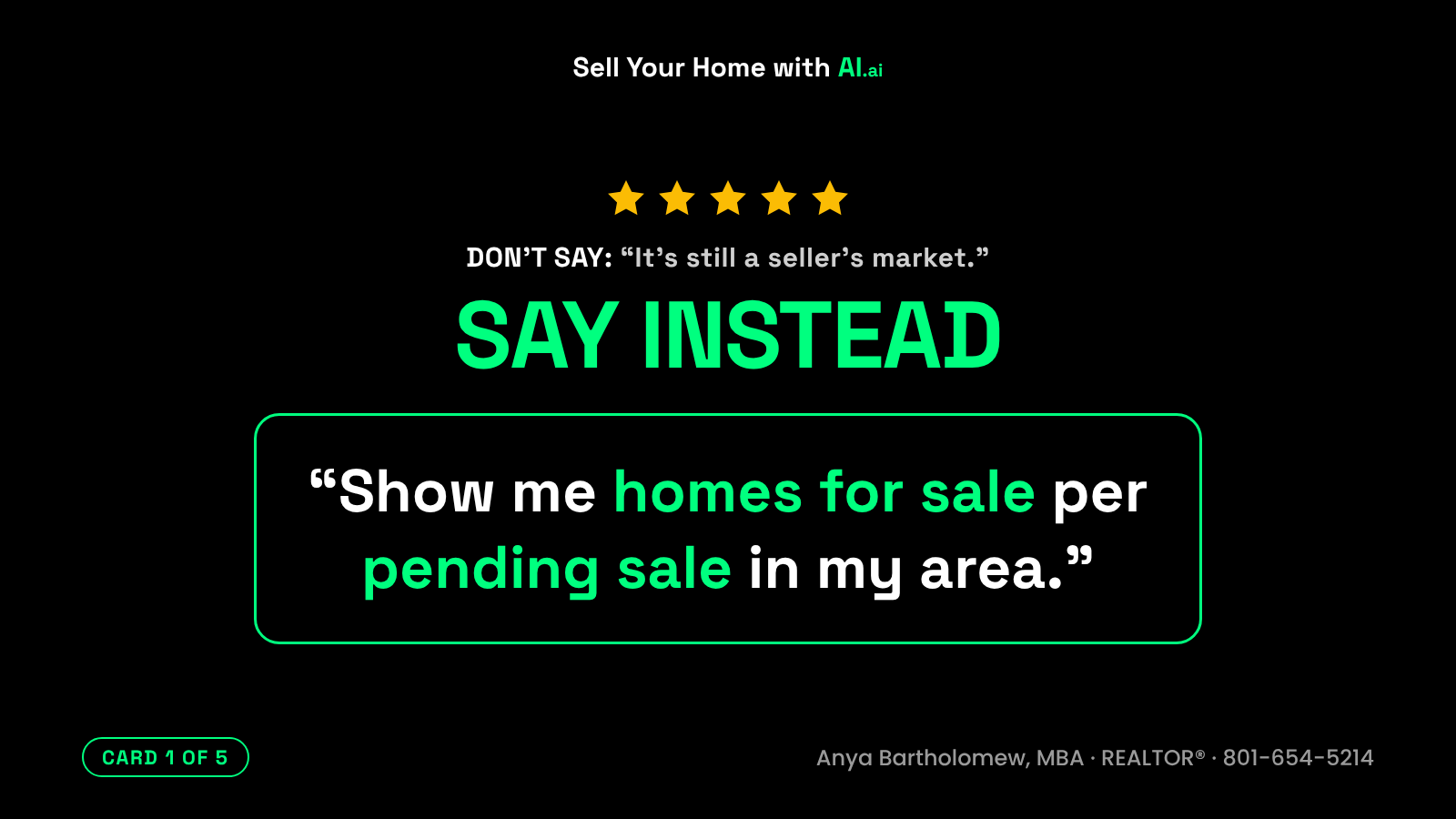
Say instead: "Show me homes for sale per pending sale in my area."
2. The numbers: six Augusts in Salt Lake County, and the day the balance broke
Here is the full table. Every August, six years, Salt Lake County, from the Utah Association of REALTORS® Local Market Update.
August | 2021 | 2022 | 2023 | 2024 | 2025 | 2026 |
|---|---|---|---|---|---|---|
Homes for sale | 1,627 | 2,709 | 2,642 | 2,971 | 3,667 | 4,140 |
Pending sales | 1,632 | 1,180 | 998 | 906 | 1,155 | 846 |
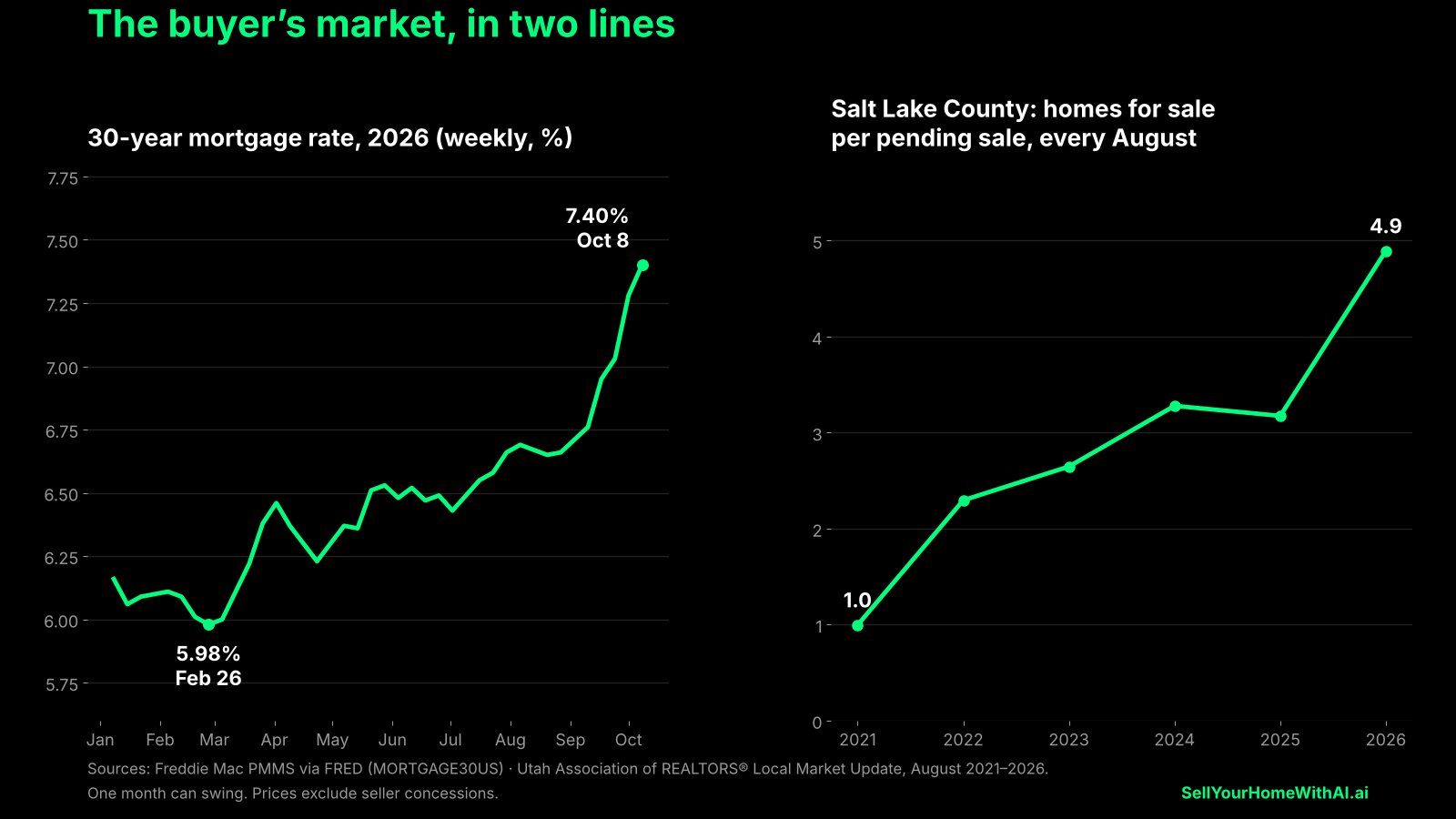
Homes for sale per pending sale | 1.0 | 2.3 | 2.6 | 3.3 | 3.2 | 4.9 |
Months of supply | 1.1 | 2.1 | 2.8 | 3.0 | 3.6 | 4.0 |
Days on market until sale | 15 | 28 | 35 | 42 | 58 | 56 |
% of original list price received | 101.8% | 96.5% | 97.3% | 97.2% | 96.3% | 96.4% |
Median sales price | $475,000 | $525,000 | $520,000 | $530,000 | $555,000 | $554,990 |
Closed sales | 1,640 | 1,209 | 1,167 | 1,070 | 1,146 | 987 |
New listings | 1,922 | 1,635 | 1,581 | 1,471 | 1,483 | 1,546 |
How to read it:
The line that matters is row 3. One buyer per home in 2021. Almost five homes per buyer in 2026. That is the whole story of the shift.
Supply doubled twice. 1.1 months in 2021. 4.0 months in 2026. Most economists call 4 to 6 months a balanced market. We just arrived at the bottom of that range from below, and the September rate jump came after this report.
Prices did not fall. August alone looks flat: $555,000 in 2025, $554,990 in 2026. Year to date, the median is up 2.0% ($543,950 → $555,000). The federal house price index for the Salt Lake City metro agrees: up 2.4% from mid-2025 to mid-2026 (FHFA index on FRED). Two sources agree. Sellers held the line. Buyers answered by not buying: closed sales fell 13.9%.
The August 2026 pending number is the lowest August in six years. 846. Lower than 2023 and 2024, the two slow years.
One caution, because the UAR report says it: one month can swing. Pending sales for January through August 2026 were 8,664, almost the same as 2025 (8,681). The year was flat until August. August is when it broke. September's rate jump came after that.
The September report is days away. The Utah Association of REALTORS® posts each month's county numbers around the middle of the next month. The September 2026 report is the first one that will show the full rate jump. I will add it to this post the day it comes out. Stay tuned.
A second source agrees on the direction. Realtor.com data for the Salt Lake City metro shows active listings at 3,923 in September 2026, up 14.1% from September 2025 and the highest September since 2019 (FRED, active listing count). Two sources agree.
3. "There are plenty of buyers out there." — Where did the buyers go?
Short answer: Fewer than there were, and they are waiting. Salt Lake City metro pending listings were 1,607 in May 2026 and 1,291 in August, down 19.7% in three months, before the rate jump (Realtor.com data). UAR counted 846 pending sales in August, down 26.8% from August 2025. Buyers did not disappear. They stopped signing.
The buyer pool shrank in two steps.
Step one: the spring buyers signed and left. Every spring the pending count peaks. In 2026 it peaked in May. Then it dropped through the summer, as it does every year, but to a lower floor.
Step two: the rate jump stopped the ones who were still deciding. A buyer pre-approved in July at 6.5% is looking at 7.4% in October. The same buyer, the same income, a smaller loan. Some of them re-ran the numbers and stopped. The next section shows the math.
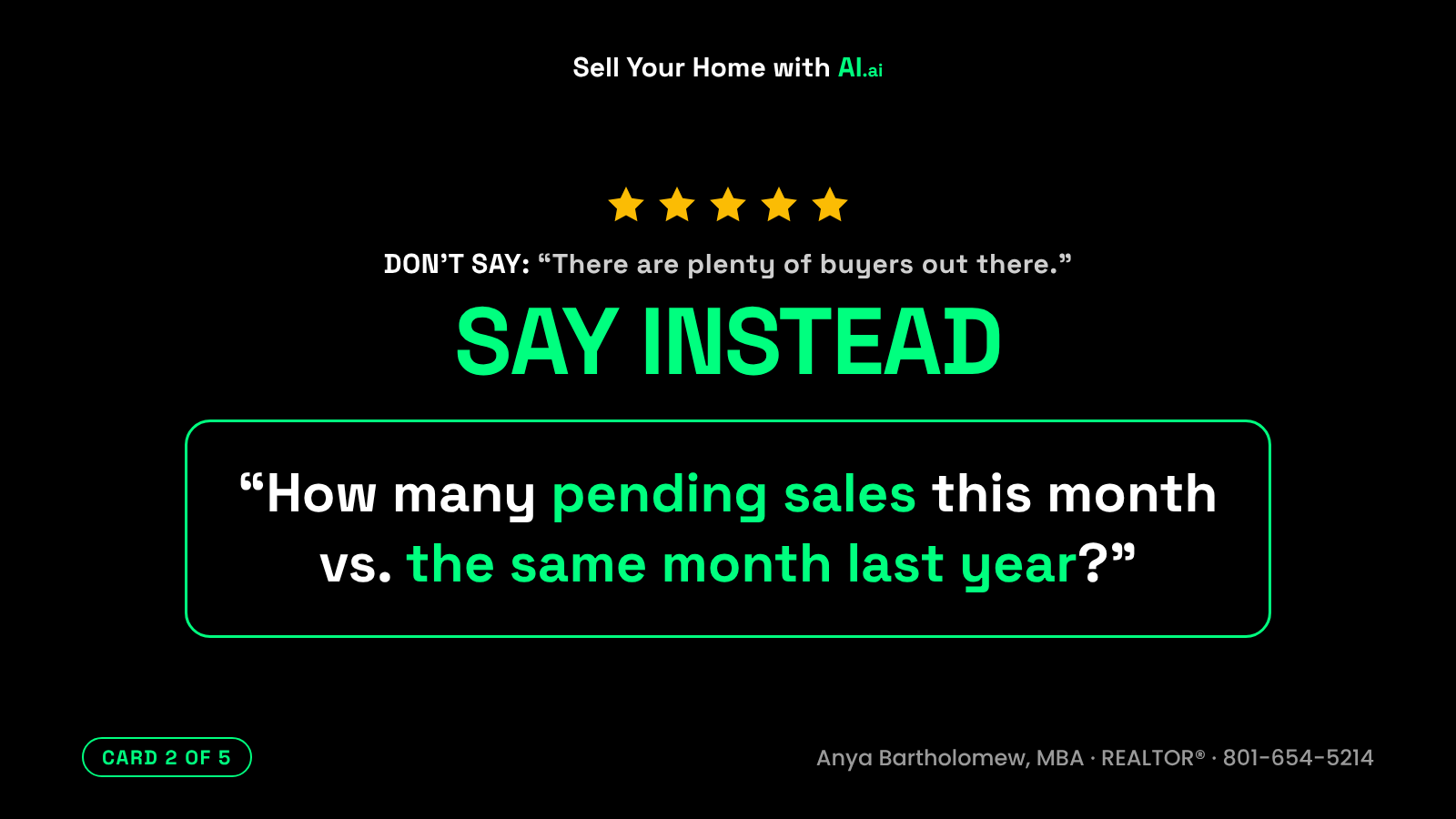
Say instead: "How many pending sales this month vs. the same month last year?"
If an agent cannot answer that in a first meeting, with a source, that tells you what you need to know.
4. The numbers: pending sales, the nearly 30% drop, and what the Fed did on September 16
Two sources count pending sales in our market. They do not use the same method. I show both.
Salt Lake City metro, pending listings (Realtor.com data on FRED):
2026 | Pending listings | Change from May |
|---|---|---|
May | 1,607 | — |
June | 1,597 | −0.6% |
July | 1,392 | −13.4% |
August | 1,291 | −19.7% |
Salt Lake County, pending sales (Utah Association of REALTORS®):
Aug 2025 | Aug 2026 | Change | |
|---|---|---|---|
Pending sales | 1,155 | 846 | −26.8% |
Homes for sale | 3,667 | 4,140 | +12.9% |
Closed sales | 1,146 | 987 | −13.9% |
These two sources don't agree on the size of the drop. One says 19.7% from the spring peak. One says 26.8% from a year ago. They count different areas (the metro vs. the county) and compare different months. They agree on the direction: down, hard, before the rate jump.
Nationally, the picture is the same. NAR's August report: pending sales were down 4.7% from a year ago, and in the West, down 6.7% (NAR, September 17, 2026). NAR's chief economist said it plainly: "the housing market is still sluggish, with contract signings below last year," because of "higher mortgage rates offsetting the increased buying power created by job gains."
Then the Federal Reserve raised rates. On September 16, 2026, the Fed raised its target rate by a quarter point to 3.75%–4.00%, by a 12–0 vote, the first increase since July 2023. Its own words: "Inflation remains elevated" (Federal Reserve, September 16, 2026).
Mortgage rates do not follow the Fed rate directly. They follow the 10-year Treasury yield, which hit 5.31% on October 5 (Federal Reserve data on FRED). The mortgage rate followed within weeks:
Week ending | 30-year fixed rate |
|---|---|
September 10, 2026 | 6.76% |
September 17, 2026 | 6.95% |
September 24, 2026 | 7.03% |
October 1, 2026 | 7.28% |
October 8, 2026 | 7.40% |
Source: Freddie Mac Primary Mortgage Market Survey. Four weeks. Up 0.64 points. The buyers who were still hanging on, waiting for a reason, got one.
5. "Rates will come down soon." — What did the rate jump do to your buyer?
Short answer: It cut your buyer's budget by about 14%. A buyer who could afford an $800,000 loan at 5.98% in February can afford about $691,000 at 7.40% for the same monthly payment. On a 20% down purchase, that is a $1,000,000 buyer who became an $864,000 buyer. Your home did not change. Your buyer did.
Nobody knows where rates go next. The Fed's own September projection shows its rate at 4.1% at the end of 2026 and 4.1% at the end of 2027 (Federal Reserve, Summary of Economic Projections, September 16, 2026). That is not a cut. Plan with the rate on the screen today.
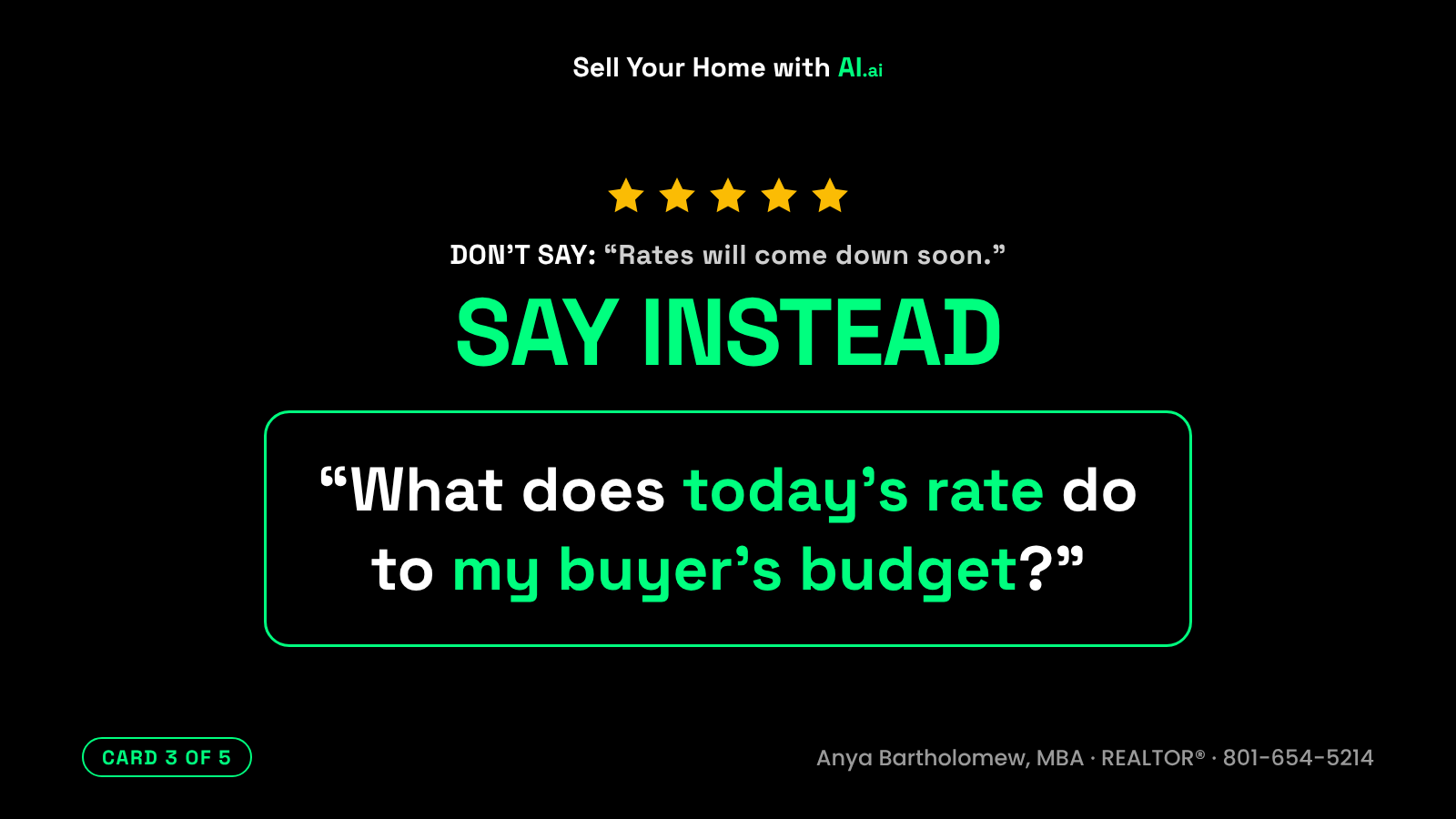
Say instead: "What does today's rate do to my buyer's budget?"
Not a lender, but what other sellers do: ask your agent to run the buyer's payment at today's rate for your list price, and for the list price 5% lower. Then look at which one the buyers in your price band can actually afford.
6. The math: $800,000 loan at 5.98% vs. 7.40%
The buyer for a $1,000,000 home in Salt Lake County, with 20% down, borrows $800,000. Here is that loan at the low of 2026 and at today's rate. Principal and interest only. Taxes, insurance and HOA on top.
February 26, 2026 | October 8, 2026 | Difference | |
|---|---|---|---|
30-year fixed rate | 5.98% | 7.40% | +1.42 points |
Loan | $800,000 | $800,000 | — |
Monthly payment | $4,786 | $5,539 | +$753 a month |
Per year | $57,433 | $66,468 | +$9,035 |
Over 30 years | $1,723,000 | $1,994,000 | +$271,000 |
Rates: Freddie Mac. Payments are standard amortization math; round numbers.
Now turn it around. The buyer wants to keep the February payment of $4,786. At 7.40%, that payment carries a loan of about $691,000. With 20% down, a purchase price of about $864,000.
Your $1,000,000 buyer is now an $864,000 buyer. That is the 14% cut. It did not happen to your home. It happened to the people who can buy it.
A buyer cannot fix this with a lower offer alone. A 14% price cut on a $1,000,000 home is $140,000. In August 2026 Salt Lake County sellers gave up 3.6% of the original list price, not 14%. So the buyer buys a smaller home, or waits. Either way, the buyer is gone from your price band.
What that does to your price band:
Buyers who were shopping at $1,000,000 in February are now shopping at $860,000.
Buyers who were shopping at $1,150,000 are now at $1,000,000. They are your new buyers. There are fewer of them, and they have 4.9 homes to choose from each.
Buyers who were at $860,000 are now at $740,000. They are gone from your search results.
Ask your lender to confirm these numbers for your own situation.
7. "I'll sell when prices come back." — Does a lower price hurt you if you buy at a lower price too?
Short answer: Much less than you think. Sell and buy in the same market, and the discount works on both sides. You sell for 3.6% less. You buy for 3.6% less. Sideways move: the two cancel. Move up: the market helps you. Move down: you keep more equity. The only losing move is the one you do not make.
This is the point most sellers miss. You are reading the headlines as a seller. Read them again as a buyer.
Every number in this post that hurts you as a seller helps you as a buyer:
The number | As a seller | As a buyer |
|---|---|---|
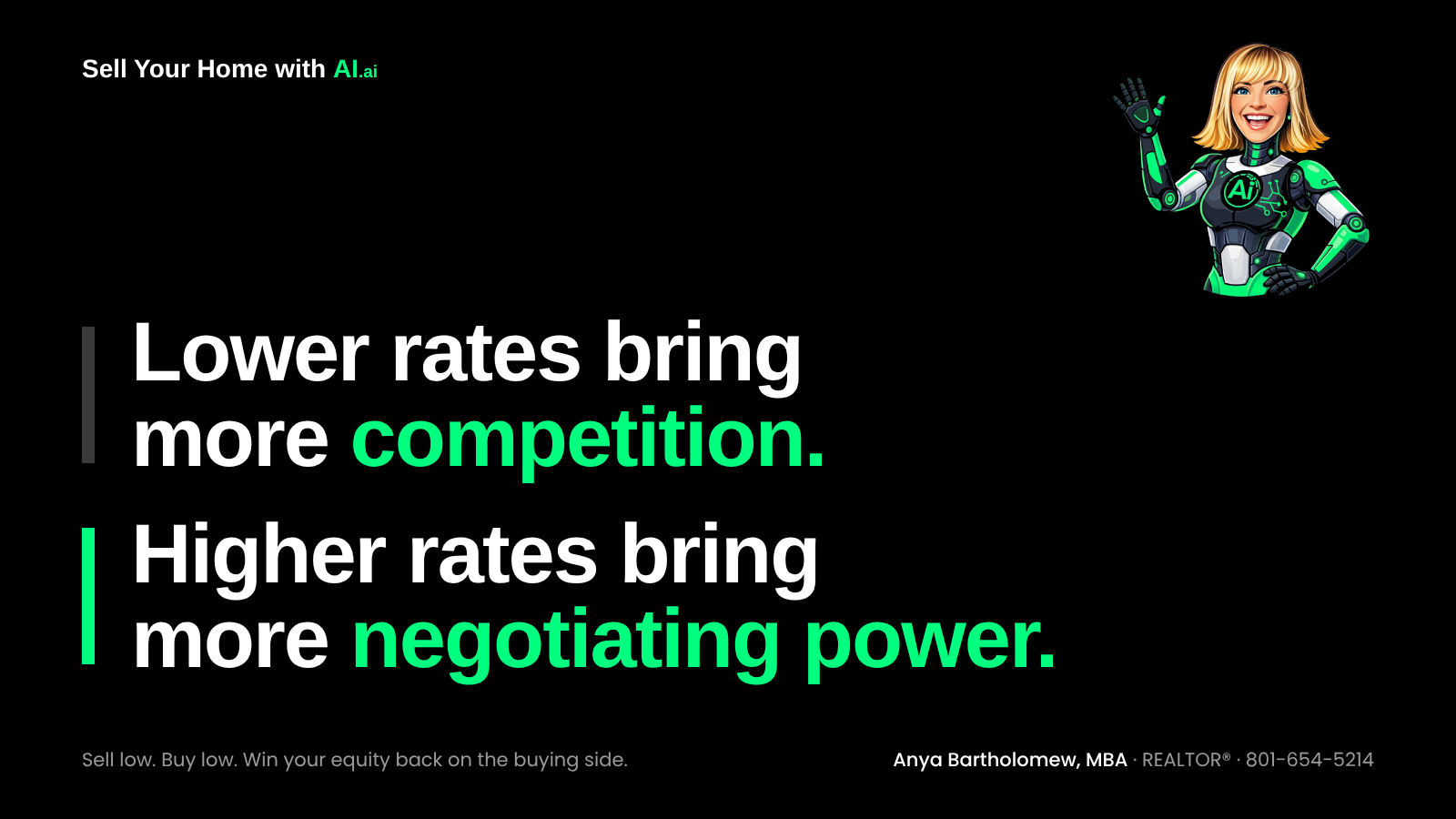
7.4% rate | Fewer buyers for your home | Lower rates bring more competition. Higher rates bring more negotiating power |
4.9 homes for sale per pending sale | Competition for your home | Choice for your next home |
56 days on market | Your home sits | You take your time |
96.4% of list price received | $36,000 off on $1,000,000 | $36,000 off on $1,000,000 |
Seller concessions rising | Your net is lower | Your closing costs are covered |
Buyers down 27% | Fewer offers for you | Fewer bidders against you |
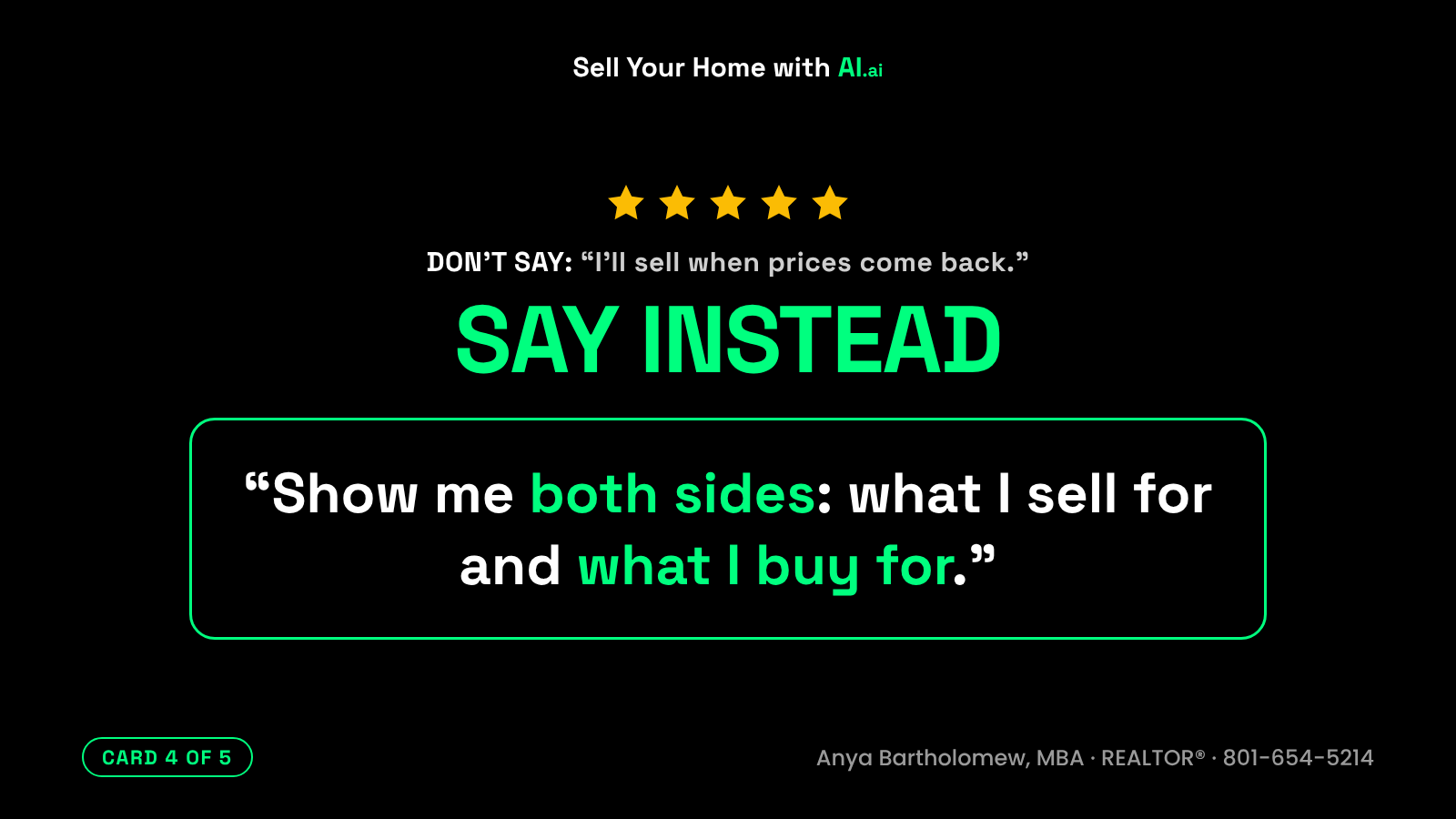
Say instead: "Show me both sides: what I sell for and what I buy for."
8. The math: sell low, buy low, at $1,000,000
Three sellers. All three own a $1,000,000 home in Salt Lake County with $600,000 of equity. All three face the same market: 96.4% of list received. All three buy their next home in the same market and get the same 3.6% off.
Seller A: moves sideways. Sells at $964,000. Buys a $1,000,000 home for $964,000.
Sold for $36,000 less than list.
Bought for $36,000 less than list.
Net effect of the buyer's market: $0.
Seller B: moves up. Sells at $964,000. Buys a $1,400,000 home for $1,349,600.
Sold for $36,000 less than list.
Bought for $50,400 less than list.
Net effect of the buyer's market: +$14,400 in Seller B's favor.
Seller C: moves down. Sells at $964,000. Buys a $700,000 home for $674,800.
Sold for $36,000 less than list.
Bought for $25,200 less than list.
Net effect of the buyer's market: −$10,800. But Seller C's new loan is about $111,000 instead of $400,000.
Now add the rate. Seller A's new loan is smaller than most buyers' because the equity carries over. Seller A clears $564,000 at closing ($964,000 minus the $400,000 loan) and borrows $400,000 for the next home. At 7.40% that is $2,770 a month. A first-time buyer for the same home, with 20% down, borrows $771,200 and pays $5,340. The rate shock hits the buyer with no equity. It touches the seller with equity half as hard.
The seller with equity is the strongest buyer in this market. That is you. The average Utah homeowner holds about $304,570 in equity (Kem C. Gardner Policy Institute, September 2026).
One line on taxes: up to $250,000 of the gain on your home sale is tax-free, $500,000 for a couple, if you lived in it 2 of the last 5 years (IRS Topic 701). Not a CPA, but what other sellers do: run the gain with one before listing.
Listing expired or cancelled? My offer: sell your home in 28 days or get a cash offer. Costs and conditions apply. Ask me for the written terms.
9. "We'll wait one more year." — What does it cost you not to sell?
Short answer: More than the discount. A year of waiting in a flat market has a price in money: carrying costs, repairs, a year of the life you are paying for and not living. It has a price in risk: 4.9 homes per buyer can become 6 next August. And it has a price nobody puts on a spreadsheet: the year itself.
Three costs of waiting one year on a $1,000,000 home:
1. The carrying cost. Mortgage interest, property tax, insurance, upkeep. On a home with a $400,000 loan at 3%, the interest alone is about $12,000 a year. Property tax on a Utah primary home is charged on 55% of its value, so a $1,000,000 home is taxed as $550,000 (Utah State Tax Commission). Add insurance and repairs. Ask your CPA for your number.
2. The market risk. Homes for sale per pending sale went from 3.2 in August 2025 to 4.9 in August 2026. If it goes to 6 next year, the list-to-sold gap widens. Nobody knows. Prices in Salt Lake County rose about 2% in the past year (UAR year to date; FHFA index). Waiting for a bigger rise, in a market with rising supply, is a bet. Name it as a bet.
3. The year. This is the one I want you to sit with. The next section is about it.
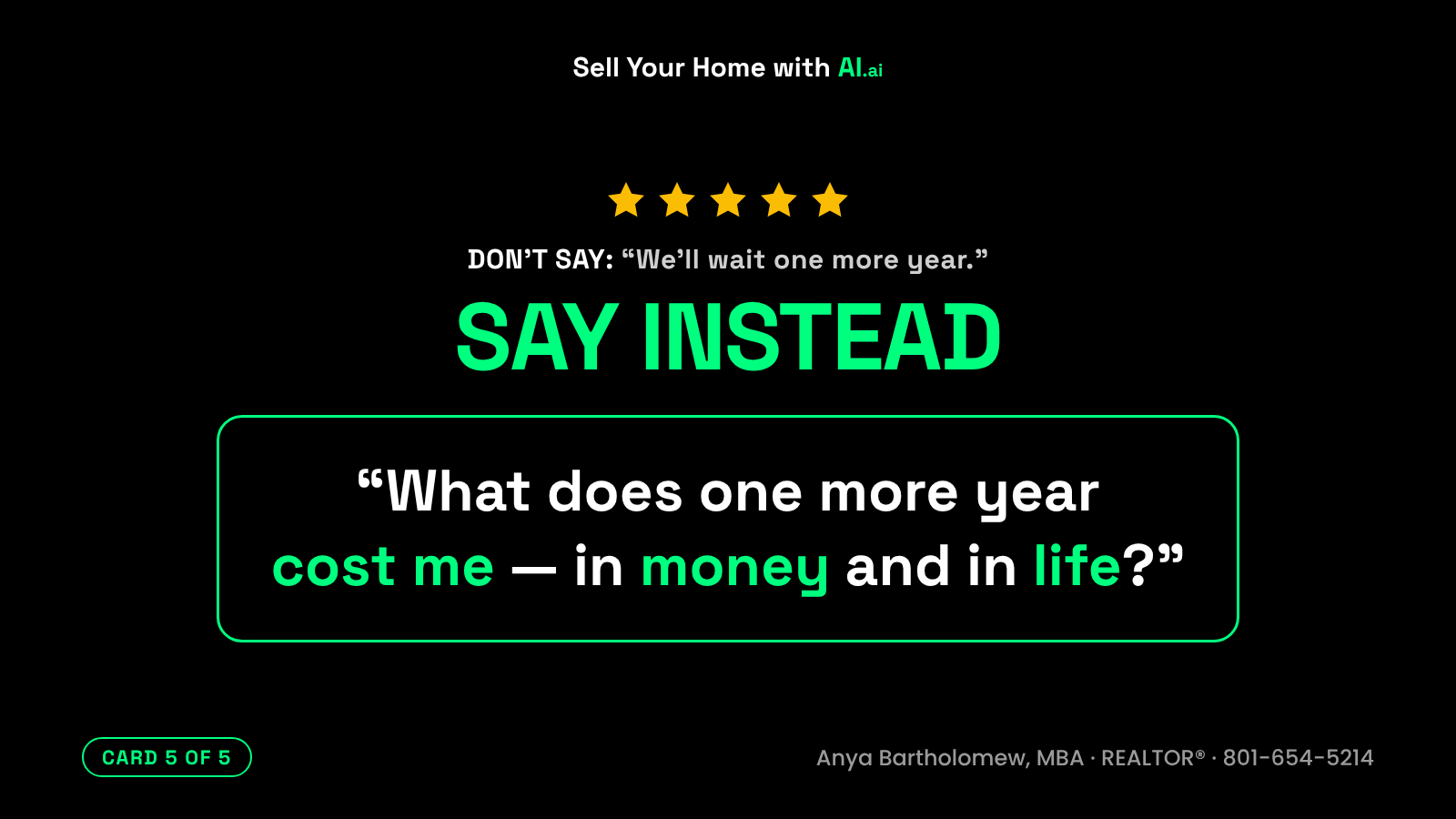
Say instead: "What does one more year cost me, in money and in life?"
10. The cost of happiness: what I have watched sellers do, and what the research says
I will tell you what I see, because the numbers cannot.
The sellers who wait are not waiting for money. They say they are. They are waiting for permission. A better rate, a better month, a neighbor who sells first. And every one of them already knows where they want to be: closer to the grandchildren, in the mountains, out of the four-bedroom house with two people in it, in the walkable place they drove through last spring.

Then one of them moves. And I get the call, or the text, or I see them at the grocery store a year later. Not one has said "I should have waited." They say "I should have done this two years ago."
The research agrees with what I see. Two Cornell psychologists studied regret over a lifetime. In the short run, people regret the things they did. In the long run, they regret the things they did not do. The pain of a mistake fades. The pain of a thing never tried grows (Gilovich and Medvec, Psychological Review, 1995).
A home is the biggest version of that. You are not deciding whether to sell a house. You are deciding whether to spend one more year, or three, in a place you have already decided to leave.
So here is the cost of happiness, in the only units that count:
The money cost of moving in a buyer's market: $0 to $36,000, depending on where you move (section 8).
The money cost of waiting a year: about $12,000 in interest plus tax, insurance and repairs, plus the bet on supply (section 9).
The life cost of waiting a year: one year. Of the number you have left. In the place you already decided to leave.
Are you willing to give up the life you want, to avoid paying the price of the life you want? Only you can answer that. I can show you the numbers. I have. The decision is yours.
11. What to do now: the 4-week feedback plan in a buyer's market
A buyer's market punishes guessing. The agent who says "let's try a high price and see" is spending your 56 days. Here is what I do instead.
Price to the data, not to 2021. Pull the sold, active and pending homes in your price band. Look at row 3 of the table in section 2 for your city, not the county. Ask: how many homes are competing with mine, and how many buyers signed last month?
Then collect buyer feedback over the first 4 weeks:
Week | What happens | What you get |
|---|---|---|
Week 1 | Grand open house week | Buyer feedback on condition and price, in writing |
Week 2 | Agent tour | Written feedback from agents who sell in your area |
Week 3 | Open house follow-up | Second open house. Follow-up with every agent who showed the home |
Week 4 | Review the showing data | Showings and feedback vs. comparable homes. You decide: continue, adjust the price, or cancel |
Why 4 weeks: Salt Lake County homes took 56 days to sell in August 2026 (Utah Association of REALTORS®). Four weeks is half that. Enough to see showings and feedback. Not enough to go stale in a market with 4.9 homes per buyer.
For more on how to collect market data that does not lie: How I Sell a Home in 28 Days: The Full Plan.
Buy with the equity you have. Section 8 showed it: a seller with $600,000 in equity borrows $400,000 for the next home, half of what a first-time buyer borrows. The rate shock is a first-time buyer's problem. Use that. In a market with 4.9 homes per buyer, a buyer with a small loan and a clean closing is the one who gets the concessions.
Not a lender, but what other sellers do: get the next home's payment in writing at today's rate before you list, so the number is a fact, not a fear.
FAQ
Should I sell my house now or wait?
Lower rates bring more competition. Higher rates bring more negotiating power. If you sell and buy in the same market, the buyer's market discount works on both sides (section 8). Waiting has its own costs: carrying costs, the bet on supply, and the year itself (section 9). Nobody knows when rates drop. The Fed's September projection shows its rate at 4.1% at the end of 2026 and 4.1% at the end of 2027 (Federal Reserve).
Is Salt Lake County a buyer's market in 2026?
Yes, by the numbers. In August 2026 there were 4,140 homes for sale and 846 pending sales, 4.9 homes for every buyer who signed a contract, and 4.0 months of supply (Utah Association of REALTORS®). In August 2021 it was 1.0 home per buyer and 1.1 months of supply.
How much did mortgage rates go up in 2026?
From 5.98% on February 26 to 7.40% on October 8, 2026, up 1.42 points. One year earlier the rate was 6.30% (Freddie Mac).
Why did pending sales drop nearly 30%?
Two steps. Salt Lake City metro pending listings fell 19.7% from May to August 2026, before the rate jump (Realtor.com data on FRED). Then the Federal Reserve raised rates on September 16, and the 30-year mortgage rate rose from 6.76% to 7.40% in four weeks. Year over year, UAR counted Salt Lake County pending sales down 26.8% in August.
Does a lower sale price matter if I buy at a lower price too?
Less than it seems. On a sideways move, the two cancel. On a move up, the buyer's market helps you. On a move down, you keep more equity. A seller with equity borrows less, so the higher rate hits a first-time buyer much harder than it hits you.
How long does it take to sell a house in Salt Lake County right now?
56 days on market until sale in August 2026. 15 days in August 2021 (Utah Association of REALTORS®).
About these numbers
Utah is a non-disclosure state (Utah State Tax Commission). Sellers do not have to report the sale price to the county. A 2026 bill to require it did not pass (HB 441, Utah Legislature).
So the main source for Utah sale numbers is the Utah Association of REALTORS®. Its numbers come straight from the MLS — the database agents use to list and sell homes.
Read them with caution: - Prices do not include seller concessions. - One month can swing. The report says so.
When sources disagree, I show both.
Figures checked October 10, 2026.
12. Your takeaway: should I sell my house now or wait, and what to say instead
Five things not to say about this market, and what to say instead.
Don't say | Say instead | Why |
|---|---|---|
"It's still a seller's market." | "Show me homes for sale per pending sale." | 1.0 in 2021. 4.9 in 2026. |
"There are plenty of buyers." | "Pending sales this month vs. last year?" | Down 26.8% in August. |
"Rates will come down soon." | "What does today's rate do to my buyer?" | A $1,000,000 buyer became an $864,000 buyer. |
"I'll sell when prices come back." | "Show me both sides: sell and buy." | The discount works on both sides. |
"We'll wait one more year." | "What does a year cost me, in money and in life?" | A year of carrying costs. One year of life. |
Should I sell my house now or wait? You now have the numbers, the sources and the math to answer it. Think for yourself. Use the resources. The decision is yours.
Listing expired or cancelled? Here is my offer: sell your home in 28 days or get a cash offer. Costs and conditions apply. Ask me for the written terms.
Questions? Call or text 801-654-5214. No obligation. Anya Bartholomew, MBA · REALTOR® · Equity Real Estate Premier Elite