
NEVER Say THIS to an Agent When Selling Your Home 2026
Anya Bartholomew, MBA · REALTOR®, Equity Real Estate Premier Elite · Utah license 5810503-SA00 (verify) · Draper, Sandy, Cottonwood Heights, Holladay, South Jordan
Published October 6, 2026 · Updated October 6, 2026 · Figures checked October 3–4, 2026
This post is not going to make me popular among real estate agents.
Interviewing listing agents over coffee should feel exciting, not like a high-stakes poker match. Still, it’s surprisingly easy for casual kitchen-table chatter to give away your best negotiating leverage before you even hire someone. Blurting out your bottom-line price or signing a rigid six-month listing without a clear marketing plan can quietly cost you serious time and equity. You deserve a true advocate who guards your confidential bargaining position from day one. Here is what not to tell your REALTOR®: five innocent phrases to keep in your pocket during that first interview, so your sale stays on your terms.
Why is this important? NAR's own 2026 member report gives the answer. The typical REALTOR® closed nine sales in 2025. Agents with two years or less in the business earned a median of $8,000 for the whole year (NAR, The Feature Sheet: 2026 Member Profile). That is less than the $9,530 a typical REALTOR® spends on business expenses. An agent who needs your listing that badly has a reason to tell you what you want to hear. This is why the Code of Ethics matters more to you than to the agent across the table. You are the one who pays for the mistake. Seller beware.
Table of Contents
"I think the house is worth around…" — Should you name your price first?
Do your homework first: three numbers to check before the meeting
"The lowest I'd take is…" — Should you tell your agent your bottom line?
The numbers: what a higher price is worth to you and to your agent
"I'm not paying a buyer agent commission." — Do you have to pay the buyer's agent?
"Sure, six months is fine." — How long should a listing agreement be?
Expired, cancelled, withdrawn: what each means for your contract
"Maybe we'll just rent it out." — Should you rent instead of sell?
Seller beware: what renting costs and where prices are going
Your takeaway: what not to tell your REALTOR®, and what to say instead
The one question that protects your equity
As a REALTOR®, I'm about to disclose to you how to protect yourself when something doesn't feel right.
The question of integrity comes up in every real estate transaction. An agent is challenged to put the client's interest first. The key word that guides this post is fiduciary. It defines the relationship between you and your REALTOR® from the moment you enter it.
Below are the five mistakes. In each one, a fiduciary duty could be missed, neglected, distorted, ignored or violated. My goal is to arm you with a check-in. We look at each mistake through one single question:
What is in the best interest of the client?
In a meeting with an agent, when you reach a point in your contract, stop. Ask yourself: "What's in my best interest?" Answer it clearly for yourself. Then say it to your REALTOR®.
Do that, and every mistake below — the equity loss, the gambling with your equity — could be avoided.
1. "I think the house is worth around…" — Should you name your price first?
Short answer: No. Don't tell a listing agent what you think the home is worth in the first meeting. Your number becomes their number. Too low, and an agent can sell fast and collect. Too high, and an agent can agree to win the listing, then cut later. Ask for their price and how they got it. Then compare.
Don't say your number first.
If your number is too low: an agent may agree, sell fast, and collect the commission. You may never know you left money behind.
If your number is too high: an agent may agree just to win the listing. Then push you to cut the price later.
The longer a home sits, the more buyers ask what is wrong with it.
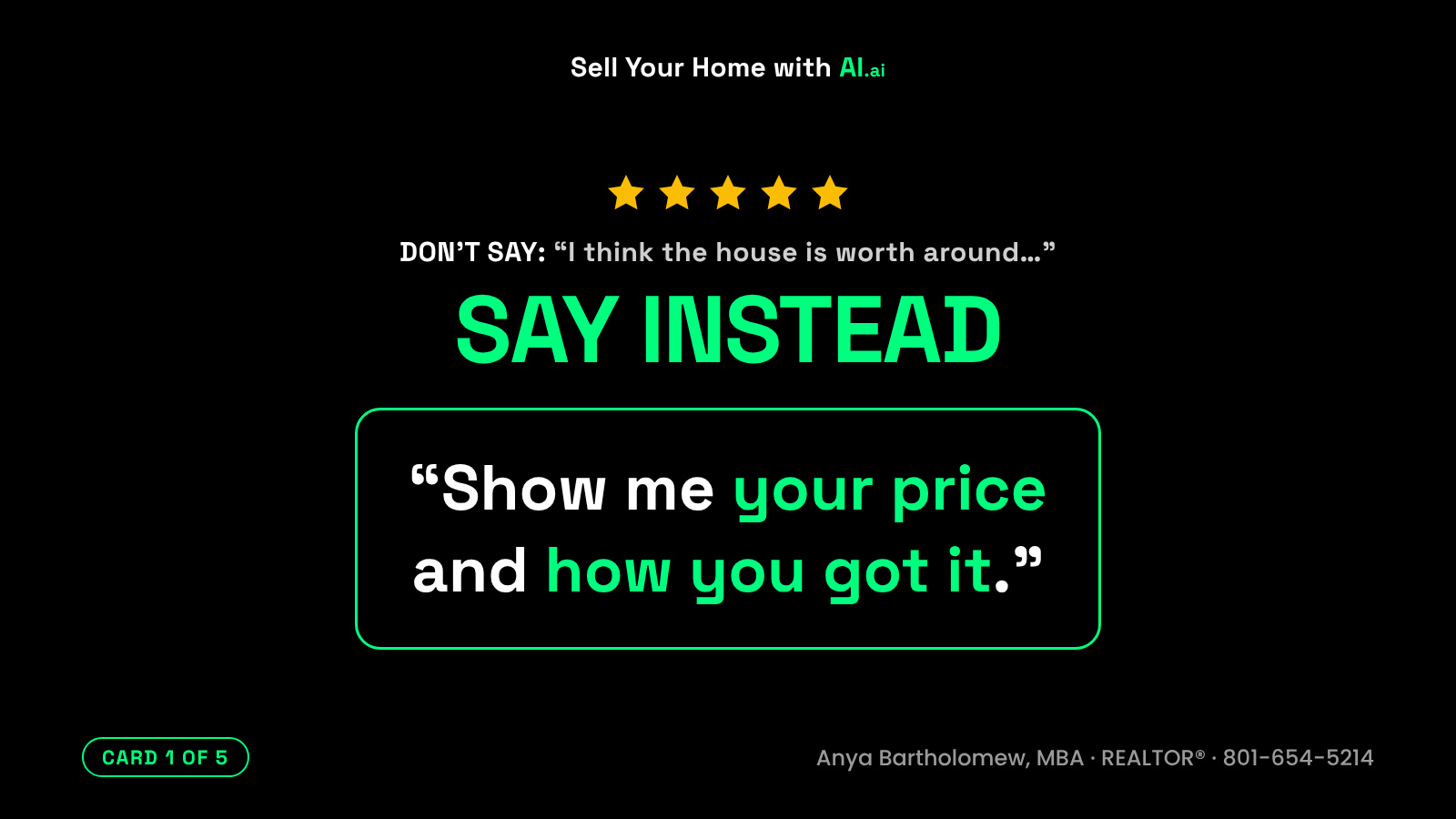
Say instead: "Show me your price and how you got it."
2. What the REALTOR® Code of Ethics says about your price
The Code has a rule for this exact moment. Standard of Practice 1-3 says a REALTOR® who is trying to win a listing "shall not deliberately mislead the owner as to market value" (NAR, 2026 Code of Ethics).
Two limits to know:
The word is "deliberately." The rule covers a deliberate act. An honest mistake about price is not covered.
The Code binds REALTORS®, the members of the National Association of REALTORS®. Not every licensed agent is a member.
This is why the question matters: "Show me your price and how you got it." A price with comparable sales behind it can be checked. A price with nothing behind it cannot.
3. Do your homework first: three numbers to check before the meeting
Recent sales near you
Days on market
Sold price vs. list price
Here is what those numbers look like in Salt Lake County, every August for six years. Source: Utah Association of REALTORS® Local Market Update.
August | 2021 | 2022 | 2023 | 2024 | 2025 | 2026 |
|---|---|---|---|---|---|---|
Median sales price | $475,000 | $525,000 | $520,000 | $530,000 | $555,000 | $554,990 |
Days on market until sale | 15 | 28 | 35 | 42 | 58 | 56 |
% of original list price received | 101.8% | 96.5% | 97.3% | 97.2% | 96.3% | 96.4% |
Homes for sale | 1,627 | 2,709 | 2,642 | 2,971 | 3,667 | 4,140 |
Months to sell every home for sale (supply) | 1.1 | 2.1 | 2.8 | 3.0 | 3.6 | 4.0 |
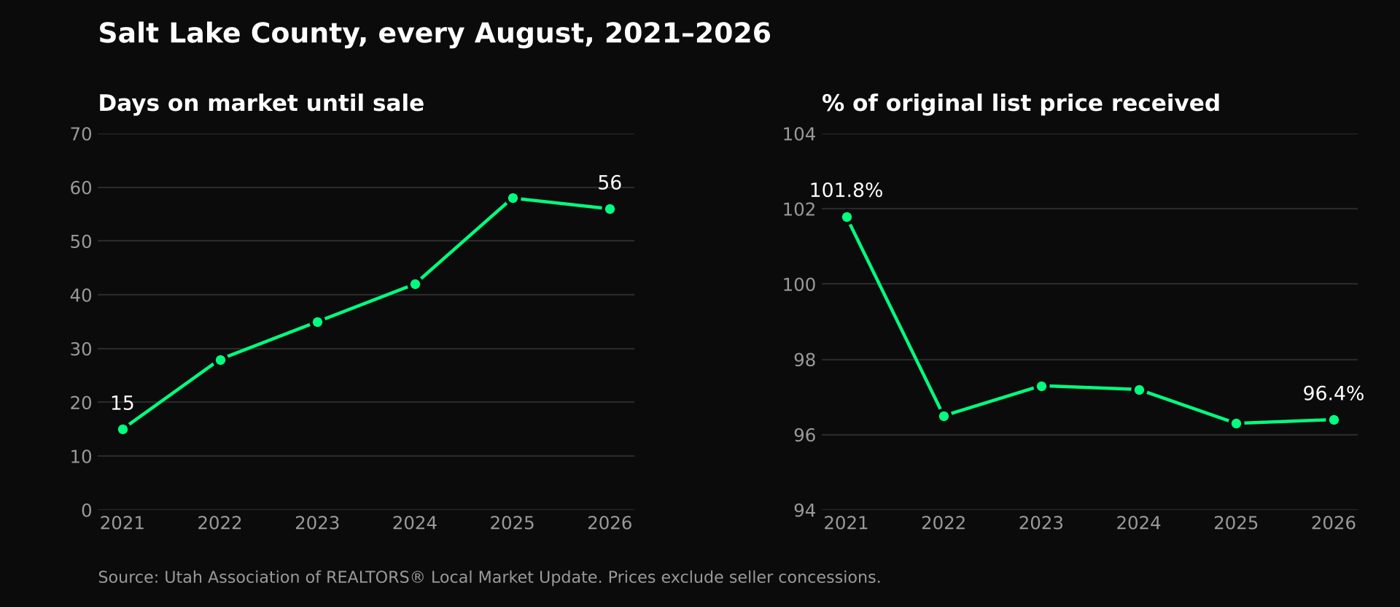
How to read it:
2021: 15 days, 101.8% of list. Your number did not matter much. Buyers set the price.
2026: 56 days, 96.4% of list, 4 months to sell what is for sale. Your number matters.
Days on market. Yours sold in 4 days with one offer? It was likely underpriced.
Sold price vs. list price. On a $1,000,000 list price, 96.4% is $964,000. That is the county average gap, before concessions.
August is the example month. The same report comes out every month, free, at the link above.
4. "The lowest I'd take is…" — Should you tell your agent your bottom line?
Short answer: Not yet. Your lowest number is your leverage. Once an agent knows it, the floor can become the target price, and the push for more gets softer. Ask for their price and plan first. Once you trust them, tell them. They need it then to protect it.
Your lowest number is your biggest piece of leverage.
Don't give it away in the first meeting.
Once an agent knows it, two things can happen:
They push less. The extra effort means tens of thousands to you. To them, a slightly bigger check.
They price to your floor, not the market. Your floor is the easier sale.
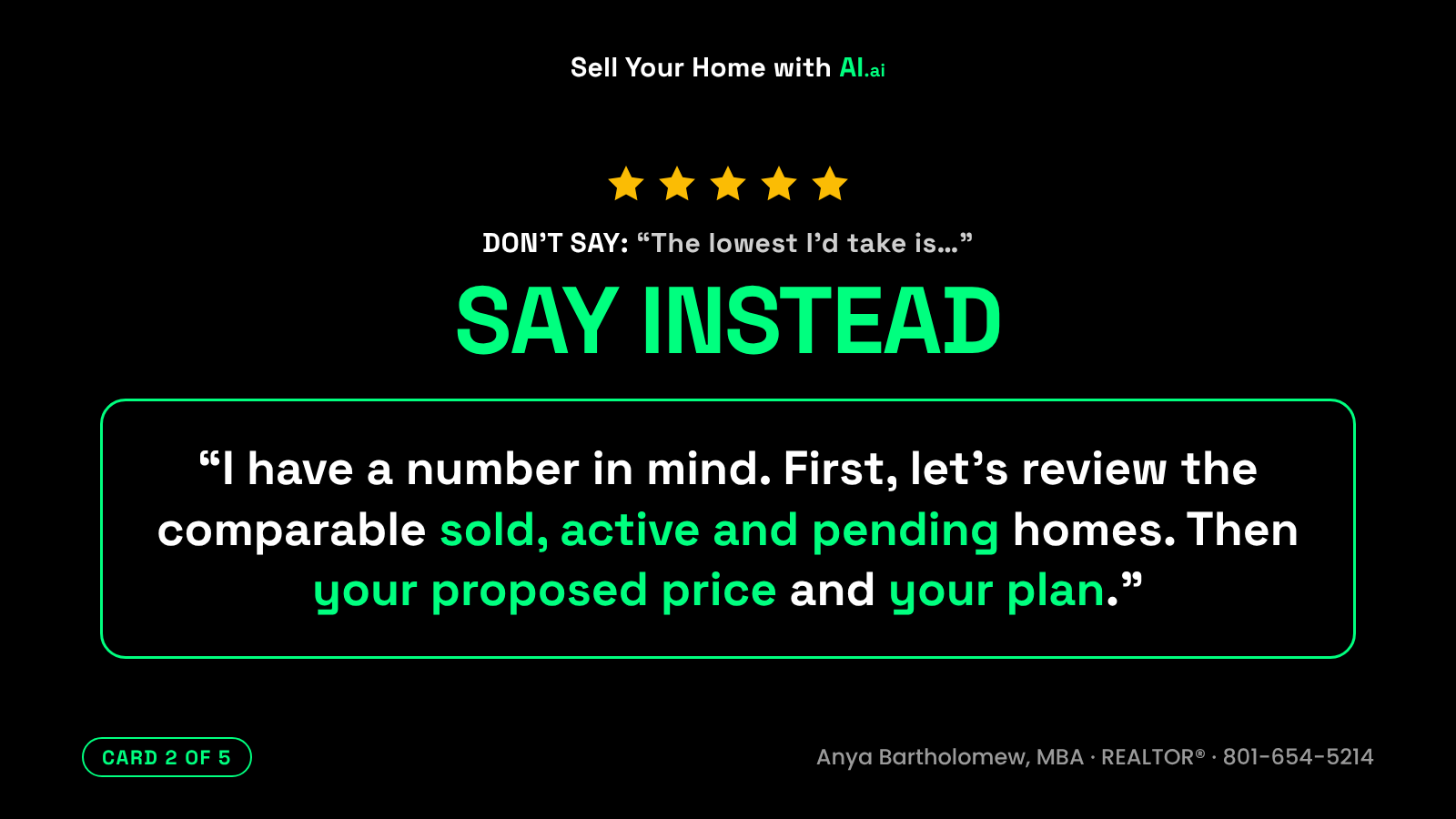
Say instead: "I have a number in mind. First, let's review the comparable sold, active and pending homes. Then your proposed price and your plan."
Later — once you trust your agent — tell them your number. They need to know it to protect it.
5. What NAR says about your confidential information
Know this first. Whatever number you discuss in private with your REALTOR®, the only price your agent may share with anyone else is the price in the MLS, unless you give permission. That is the fiduciary duty. Remind your agent of it.
Utah's rule says the same. An agent may not disclose, without permission, information from the client that would weaken the client's bargaining position (Utah Administrative Code R162-2f-401a). This binds every licensed agent in Utah, REALTOR® or not.
NAR's Code backs this up. Under Standard of Practice 1-9, a REALTOR® may not reveal a client's private information, and may not "use confidential information of clients to the disadvantage of clients" (NAR, 2026 Code of Ethics). The duty continues after the listing ends.
Two limits to know:
The rule is written for clients. In a first meeting, before you sign, you are not a client yet.
"Confidential" is defined by state law, not by the Code.
This is why the timing matters. Give your lowest number after you have signed with the agent you chose, not while you are still comparing agents.
6. The numbers: what a higher price is worth to you and to your agent
Do the math on $10,000. If your home sells for $10,000 more, you keep almost all of it. At a 3% fee, the listing side earns about $300 more, before the brokerage takes its share. For that $300, the agent must accept more days on the market.
Research measured this. Two University of Chicago economists compared homes that agents sold for clients with homes the agents owned themselves. Agents kept their own homes on the market about 9.5 days longer and sold them for about 3.7% more (Levitt and Syverson, National Bureau of Economic Research).
On a $1,000,000 home, 3.7% is $37,000.
The study is from 2005. The way agents are paid has not changed.
7. "I'm not paying a buyer agent commission." — Do you have to pay the buyer's agent?
Short answer: No. Since August 17, 2024, buyer agent pay cannot be offered in the MLS, and you negotiate it. But decide after you hear the plan. Without buyer agent pay, some buyers never see the home. Ask: "How do we stay competitive without it?" A strong agent has an answer.
Your home. Your choice.
Decide after you hear the plan.
Since August 17, 2024 (NAR, 2024):
A buyer signs a written agreement with their agent before touring a home.
Buyer agent pay can no longer be offered in the MLS.
You can still offer it. You negotiate it.
If an agent says "No problem" and explains nothing, that is a warning.
No buyer agent pay can mean:
Fewer showings
Fewer offers
More days on market
Price cuts later
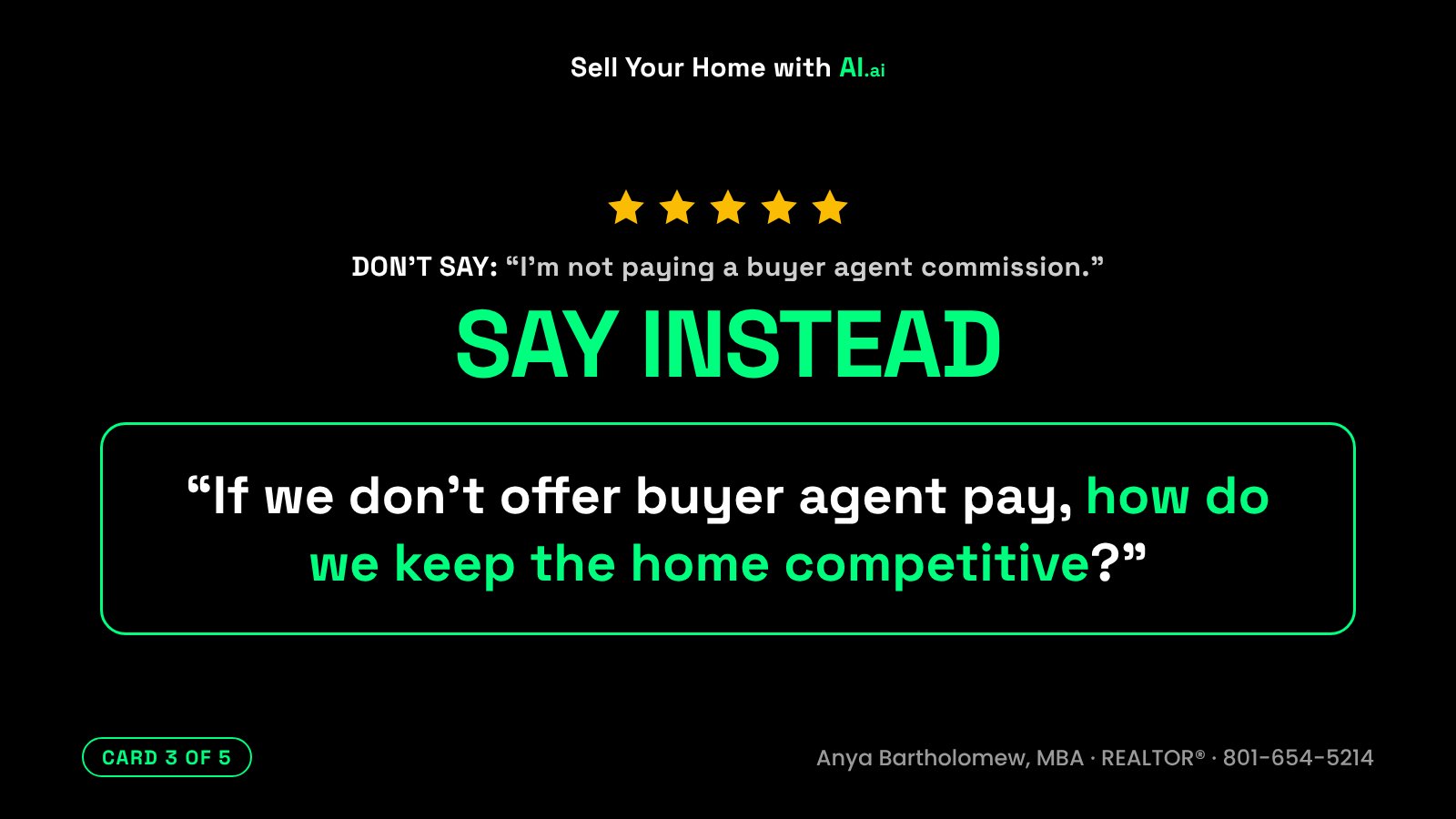
Say instead: "If we don't offer buyer agent pay, how do we keep the home competitive?"
A weak agent gets defensive.
A strong agent gives you a plan.
You decide. The agent explains the options.
8. What the research says about buyer agent commissions
You can say no, and your REALTOR® has to tell you so. Under Standard of Practice 1-12, a REALTOR® must advise a seller that broker compensation is not set by law and can be negotiated (NAR, 2026 Code of Ethics).
But "no" has a cost. The Federal Reserve measured it (Federal Reserve, May 12, 2025):
Commissions and related costs were about $170 billion in 2024. That is 0.6% of the U.S. economy.
Since the August 2024 rule change, buyer agent commissions "have remained at relatively high levels."
The reason: sellers find it costly to go below the local norm. Low-commission listings can perform poorly or get less cooperation from other brokerages.
In Utah, the question comes back in the offer. Since August 2024, the state purchase contract lets a buyer ask the seller to pay the buyer's brokerage (Utah Association of REALTORS®, August 9, 2024). You can refuse in the listing agreement and still see the request in the offer.
This is why the question to ask is about the plan, not the fee.
9. "Sure, six months is fine." — How long should a listing agreement be?
Short answer: Shorter than 6 months, with a test inside it. The contract term matters as much as the commission. It is how long you are locked in. Ask for a 4-week feedback plan: buyers and agents tell you what they think of the condition and the price, in writing, before you decide anything.
Many agents hand you 6 months.
That protects the agent, not you.
If the marketing is weak or the price is wrong, you wait while the home goes stale.
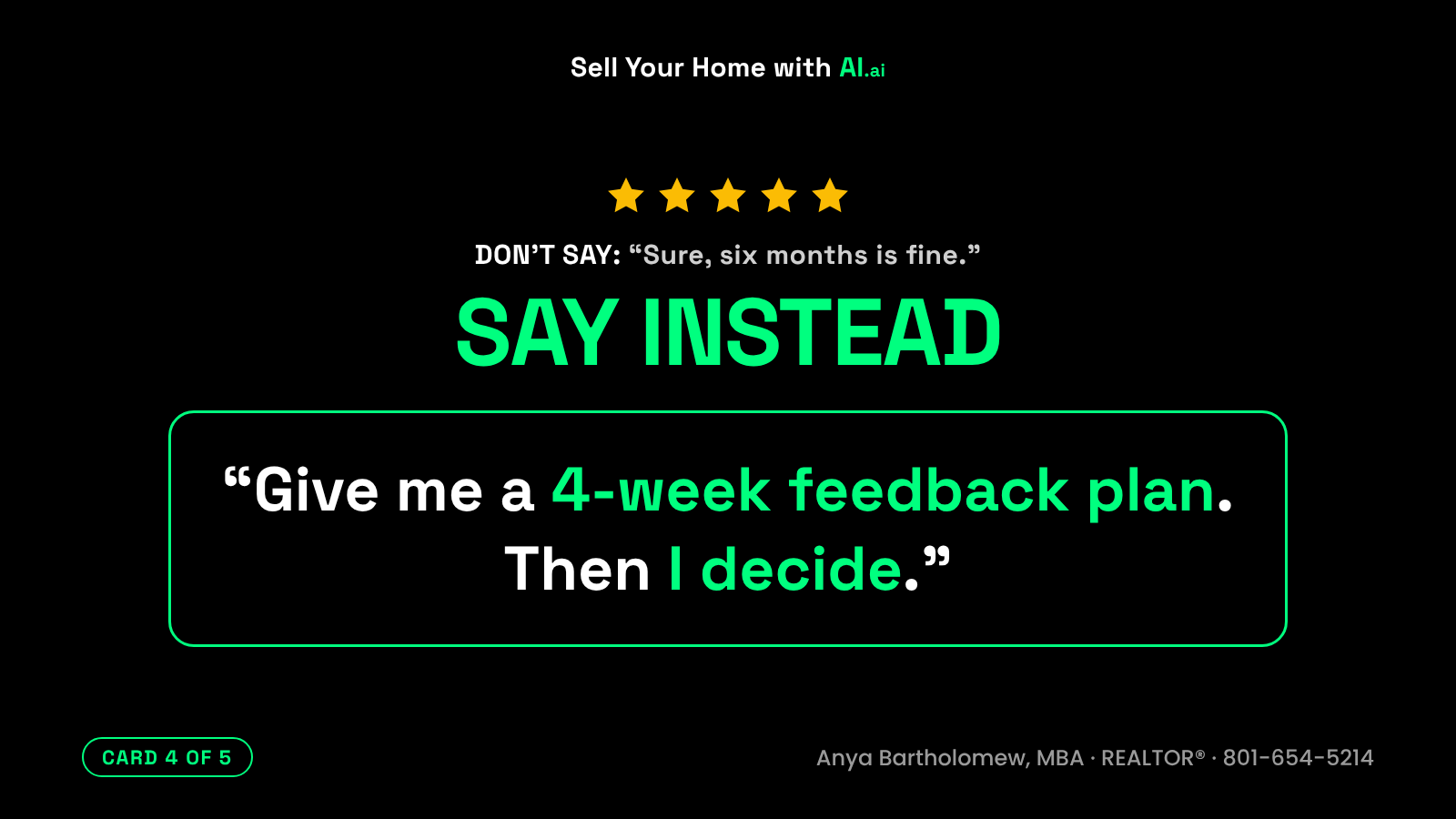
Say instead: "Give me a 4-week feedback plan. Then I decide."
Collect buyer feedback over the first 4 weeks:
Week | What happens | What you get |
|---|---|---|
Week 1 | Grand open house week | Buyer feedback on condition and price, in writing |
Week 2 | Agent tour | Written feedback from agents who sell in your area |
Week 3 | Open house follow-up | Second open house. Follow-up with every agent who showed the home |
Week 4 | Review the showing data | Showings and feedback vs. comparable homes. You decide: continue, adjust the price, or cancel |
Why 4 weeks: Salt Lake County homes took 56 days to sell in August 2026 (Utah Association of REALTORS®). Four weeks is half that. Enough to see showings and feedback. Not enough to go stale.
For more on how to collect market data that does not lie: How I Sell a Home in 28 Days: The Full Plan (link added October 13).
Before you sign, read the cancellation terms.
In Utah, a licensee must give you a copy of every document you sign, before and after signing (Utah Code 61-2f-401(8)).
Ask one question, in writing: if I cancel before the end date, do I owe commission or marketing fees? Some agreements say yes. Know before you sign.
If an agent says 6 months is the only option — that is not confidence. That is protection.
Also in the agreement. Ask about each one before you sign:
Cancellation: how, when, and what it costs.
Marketing: what the agent pays for, what you pay for.
Limited agency: whether the agent may also represent a buyer on your home. In Utah that needs your written consent (Utah Code 61-2f-401(2)). You can say no.
Showings: who gets access, and whether you are copied on every showing request and every feedback reply.
Reports: how often you get showing and feedback numbers, and in what form.
After the term ends: whether commission is still owed if a buyer who saw the home during the listing buys it later.
10. Expired, cancelled, withdrawn: what each means for your contract
Your home is off the market. Are you free to sign with another agent? It depends on one word in the MLS.
Status | What happened | Is your contract still in force? |
|---|---|---|
Expired | The end date in your listing agreement passed | No |
Cancelled | The agreement was ended early, with a signed form | No, once the form is signed |
Withdrawn | The home was taken off the MLS | Yes. You are still under contract |
Most sellers do not know the next part. Changing the status in the MLS does not end your contract. A Utah REALTOR® association said of that practice: "This never actually canceled an agency agreement" (Utah Central Association of REALTORS®).
The standard way to end it early is a signed form: the Cancellation and Termination of the Exclusive Right to Sell Listing Agreement and Agency Disclosure. Ask for your signed copy before you speak with the next agent.
If you and the agent disagree about the contract, call the agent's broker first. The broker is knowledgeable, experienced and motivated to resolve the issue. Every time I have used this step in a difficult situation, it worked like a charm. If it does not work for you, ask an attorney.
Listing expired or cancelled? My offer: sell your home in 28 days or get a cash offer.
11. "Maybe we'll just rent it out." — Should you rent instead of sell?
Short answer: Sometimes. It is a timing decision. In Salt Lake County the median price was flat from August 2025 to August 2026, homes for sale rose 12.9%, and the 30-year rate was 7.28% on October 1, 2026. If prices are flat, waiting can take years. Check the numbers below before you decide.
Sometimes renting is the right call.
It is a timing decision, not an emotional one.
If prices are flat or falling, the next rise can take years.
Before you pull the home and rent it, check the trend.
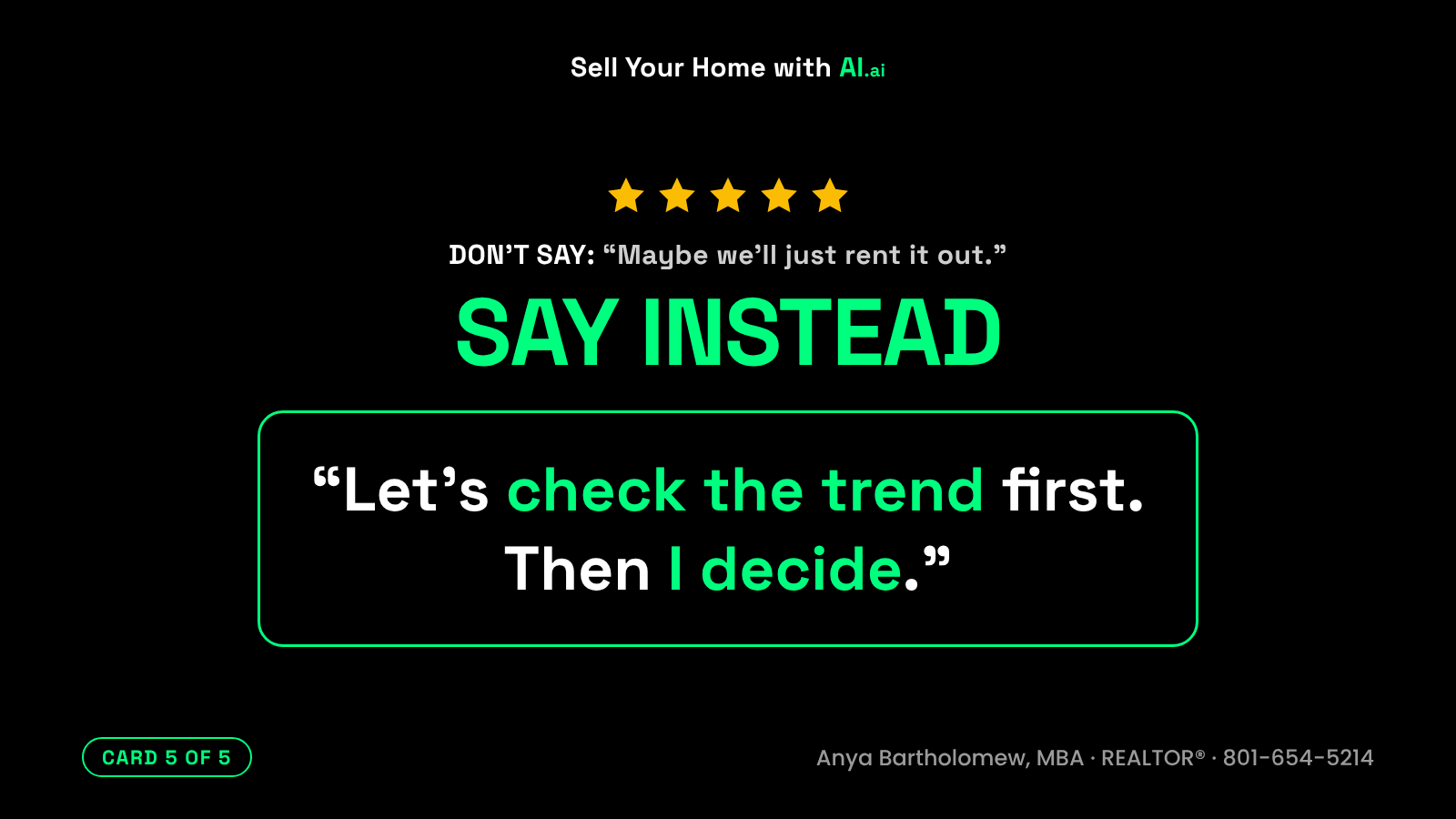
Say instead: "Let's check the trend first. Then I decide."
Renting can be a plan.
Or a reaction to uncertainty.
Know which one it is.
12. Seller beware: what renting costs and where prices are going
1. Renting is a liability. It comes with hidden costs: months with no tenant, repairs, property management, landlord insurance and tax. One example: up to $250,000 of the gain on a home sale is tax-free ($500,000 for a couple), but only if you lived in the home 2 of the last 5 years (IRS). Renting the home can change that. Ask your CPA.
2. Real estate moves in cycles of 7 to 10 years. If we are on the way down, accept the risk: 1 to 2 years from now your home may sell for less than it can today. Or you wait for the next rise.
Here is where prices stand.
Salt Lake County, August 2025 → August 2026 (Utah Association of REALTORS®):
Aug 2025 | Aug 2026 | Change | |
|---|---|---|---|
Median sales price | $555,000 | $554,990 | 0.0% |
Homes for sale | 3,667 | 4,140 | +12.9% |
Months to sell every home for sale (supply) | 3.6 | 4.0 | +11.1% |
Days on market until sale | 58 | 56 | −3.4% |
Closed sales | 1,146 | 987 | −13.9% |
All of Utah, January–March 2025 → January–March 2026 (Kem C. Gardner Policy Institute, 2026):
Median sale price: $500,000 → $520,000
These two sources don't agree.
One shows flat prices. The other shows a 4% rise.
They measure different areas and different months.
30-year mortgage rate: 7.28% on October 1, 2026 (Freddie Mac).
13. Three remedies when an agent crosses the line
Agents know these three steps. Most sellers do not. Use them in this order.
Remedy | What it does | Limits | |
|---|---|---|---|
1 | The agent's broker | Every sales agent in Utah works under a broker. Call the broker first. Most problems end here. | Informal. Nothing is decided in writing. |
2 | An ethics complaint to the REALTOR® association | A committee reviews the complaint. A hearing panel can order training or sanctions. | Only against a REALTOR®. You have 180 days from the day you knew. You must name the Code articles. |
3 | A complaint to the Utah Division of Real Estate | The state investigates license-law violations and can take enforcement action. | It does not recover money for you. For money, you need an attorney. |
Before step 2, there is a free middle step. The Utah Association of REALTORS® has an ombudsman program: an experienced broker talks with both sides, with no obligation. Call (801) 676-5200 (Utah Association of REALTORS®, ethics). If your agent belongs to the Salt Lake Board of REALTORS®, the complaint goes to that board.
Know what the state will not do. The Division "does not mediate or resolve professional or personal disputes" (Utah Division of Real Estate). Its phone is (801) 530-6747.
Sellers do use step 3. From January to March 2026, the Division received 105 real estate complaints, closed 142 cases and had 248 open (Division newsletter, first quarter 2026).
The five mistakes in this post are the reason to know all three before you sign.
FAQ
What should you never tell a REALTOR® at a first meeting?
Five things: your price, your lowest number, that you will not pay a buyer's agent, that six months is fine, and that you may just rent the home out. Ask for the agent's price and plan first. Then decide what to share.
How long should a listing agreement be?
The length matters less than what happens inside it. Ask for a 4-week feedback plan: a grand open house week, an agent tour, a follow-up open house, then a review of the showing data against comparable homes. Then you decide. Salt Lake County homes took 56 days to sell in August 2026 (Utah Association of REALTORS®). Four weeks is enough to see the data. Six months covers the agent. The full method: How I Sell a Home in 28 Days (link added October 13).
Can I cancel a listing agreement in Utah?
It depends on the agreement. Some say commission is still owed if you cancel before the end date. Read the cancellation section before you sign. Utah requires the agent to give you a copy of every document you sign (Utah Code 61-2f-401(8)). Ask for the cancellation terms in writing.
Do I have to pay the buyer's agent in Utah?
No. Since August 17, 2024, buyer agent pay cannot be offered in the MLS, and buyers sign a written agreement with their own agent (NAR, 2024). You can still offer it. It is negotiated.
How long does it take to sell a house in Salt Lake County?
56 days in August 2026. 15 days in August 2021 (Utah Association of REALTORS®).
Should I tell my agent my bottom line?
Not in the first meeting. Ask for their price and plan first. Once you trust them, yes. They need it to protect it.
Is Utah a non-disclosure state?
Yes. Sellers do not have to report the sale price to the county (Utah State Tax Commission). A 2026 bill to require it, HB 441, did not pass (Utah Legislature).
About these numbers
Utah is a non-disclosure state (Utah State Tax Commission).
Sellers do not have to report the sale price to the county.
A 2026 bill to require it did not pass (HB 441, Utah Legislature).
So the main source for Utah sale numbers is the Utah Association of REALTORS®.
Its numbers come straight from the MLS — the database agents use to list and sell homes.
Read them with caution:
Prices do not include seller concessions.
One month can swing. The report says so.
When sources disagree, I show both.
Figures checked October 3–4, 2026.
14. Your takeaway: what not to tell your REALTOR®, and what to say instead
Five things not to say in your first meeting with a listing agent, and what to say instead.
Don't say | Say instead | Why |
|---|---|---|
"I think it's worth…" | "Show me your price and how you got it." | Your number anchors theirs. |
"The lowest I'd take is…" | "I have a number. First, your price and plan." | Your floor becomes the target. |
"No buyer agent pay." | "How do we stay competitive without it?" | A plan, or a warning sign. |
"Six months is fine." | "A 4-week feedback plan. Then I decide." | 6 months protects the agent. Data protects you. |
"We'll just rent it." | Check the trend first. Then decide. | Timing decision, not an emotional one. |
You now know what not to tell your REALTOR®. You have the numbers and the sources.
Think for yourself. Use the resources.
The decision is yours.
Listing expired or cancelled? Here is my offer: sell your home in 28 days or get a cash offer.
Questions? Call or text 801-654-5214. No obligation.